Article · Tree Services · After Hours · Trades
Tree Service Storm Calls: Who Answers While You're Up a Tree?
Tree service storm calls arrive all at once. An AI answering service (AI receptionist) puts urgent callers through and books estimates while you're up a tree.
TL;DR
- A storm brings three kinds of calls at once: trees on houses, cars, driveways or wires, then insurance calls, then a week of estimate requests.
- An AI answering service sorts them by phrases you choose: urgent callers go to a second number you pick, and the rest are written up or booked as estimate visits.
- Juney gives no safety advice of her own. Anything a caller hears about power lines is a line you wrote.
- Juney is $49 a month with 150 minutes (as of October 2026). Storm weeks can add top-ups of 100 minutes for $20, bought in the app.
On this page 7 sections
The storm is the busiest stretch of the year for your phone and the worst time to answer it. The calls that matter most land while you're roped into a split tree with a saw running, so the sorting has to be decided before the wind picks up.
What happens to a tree service's phone when a storm comes through?
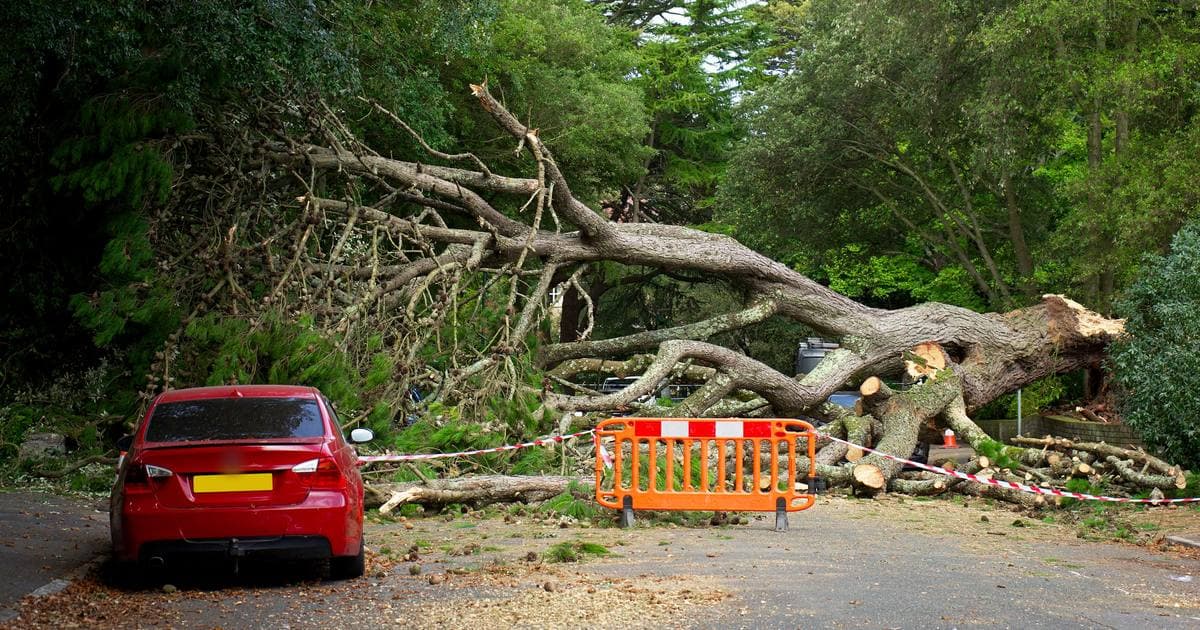
A storm turns one kind of call into three, and they arrive in waves. The first wave is damage: a tree on the house, an oak across the driveway with the car stuck behind it, a limb on the wires out front. The second comes the next morning, when homeowners have spoken to their insurer, landlords are ringing about rentals, and neighbors want to know who pays for the tree that fell over the fence.
The third wave is the long one. For a week or more, people ring about hanging limbs, a pine that's started to lean, a yard full of branches, and the stump that's been there since the last storm. Each of those is real work, and each caller will book whoever gets back to them first.
The trouble is that all three waves sound the same when the phone rings. Without picking up, you can't tell the tree on a roof from the hedge trim. That's the job an answering service does: it listens to why they're calling and handles each kind differently. Our page on the answering service for tree services shows the everyday version of those calls.
What to do: before storm season, write down the three piles your calls fall into, and the words callers use for each. Those words become the instructions.
Why can't you just answer storm calls yourself?
You can't answer from a canopy with a saw running, from a bucket truck, or standing next to a chipper with ear protection on. Storm work is cutting limbs and trunks under tension, and nobody should stop halfway through a cut to find their phone. By the time you're on the ground, the caller with a tree through the roof has rung the next company on the list.
Voicemail doesn't solve it either. A recorded "please leave a message" tells a homeowner with a branch through the bedroom ceiling that nobody's coming yet. And on a storm day you might come down to fifteen messages with no way to tell which one is urgent until you've played them all.
What to do: decide which calls must reach a person within minutes, and whose phone that is. Everything else can wait for a written summary, as long as it's a good one.
What should happen to a "tree on the house" call?
A tree on a house, a car or a driveway should reach a person while the caller is still on the line. With Juney, you set this up as a scenario: a kind of call, the phrases callers use for it, and what she does when she hears them. She asks the questions you wrote and then puts the caller through to the number you choose.
That number has to be different from the business number you forward to Juney: a second mobile, a partner, or whoever's on call that night. She rings it first and tells whoever answers who's calling and why. If they take it, she connects the caller; if nobody answers within 20 seconds, she comes back and takes a message. If you work alone with one phone, your own chance at the call is Ring me first further down, not the transfer.
Here's what a storm scenario might look like, set up in the app's scenario settings:
- Name: Storm damage
- When they say something like: "a tree came down on the house", "through the roof", "on my car", "blocking the driveway", "we can't get out"
- Asks them: What's the address? Is anyone hurt? Is the tree touching the house, a car or any wires?
- Puts them through: your second mobile, or whoever's on call
The questions are yours, so ask what you'd need to know before you load the truck. Juney asks them in her own words, then puts the caller through. The caller's answers arrive in your call notes after the call, so whoever picks up should ask for the address again.
What about a tree on a power line?
Juney doesn't decide what a caller should do about a downed line. She gives no safety advice of her own: if you want callers told something, you write it into the scenario as a line she says word for word. The safest source for that line is the wording your local power company or emergency service already publishes.
Official advice differs by country, so check yours. In the US, the National Weather Service says not to go near downed power lines and to report them. In the UK, network operators such as SSEN take reports of damage to their equipment on 105. In Australia, the NSW SES takes storm help calls on 132 500 and says to call Triple Zero (000) in a life-threatening emergency. The emergency number is 911 in the US and Canada and 999 in the UK.
A separate scenario for wires keeps it clear:
- Name: Wires down
- When they say something like: "on the power line", "the wires are down", "sparking", "limb on the lines"
- Tells them: one line copied from your utility's or emergency service's published wording, word for word
- Puts them through: your second mobile, or whoever's on call
If your business doesn't work near power lines, add a second line in your own words saying so, so the caller knows the utility comes first.
What to do: find your utility's or emergency service's published advice on downed lines (the official pages above are a place to start), copy their wording into the scenario, and make a test call to hear Juney say it.
What happens to the calls that can wait?
The calls that can wait get written up or booked, so the week after the storm doesn't start with fifteen voicemails. For a hanging limb, a leaning pine or a stump, Juney always takes the caller's number and what they need, plus whatever you set her to ask: the name, the address, the species if they know it, its rough height, and whether it's near a roof, a fence or the street. Then the summary arrives on your phone as a notification, and by email too if you turn that on.
If you connect Google Calendar, she can book the estimate visit herself. She offers times that show as free in your calendar, books the one the caller picks, and Google emails the caller an invite when she has their email. Removals are priced on site, so leave that price blank and she tells callers you'll confirm it. She doesn't price a job herself.
Storm weeks need one habit: block out the days you'll spend on emergency jobs in your Google Calendar. Juney books into whatever shows as free, so an honest calendar keeps her from promising an estimate on Thursday morning while you're clearing a road.
Insurance calls get their own scenario. Homeowners ring for paperwork, and adjusters ring for details. Ask for the claim number, the address and the best time to call back, then take a message. Juney gives no advice of her own on what a policy covers. If you send photos or a written estimate for insurers, write that into a line she says, and only if it's true for your business.
What to do: set up three scenarios for the waiting pile: estimates (book them), insurance (take a message), and everything else (take a message). Turn on Caller memory too, so when a homeowner rings for the third time, Juney remembers their earlier calls with her.
How do you cover storm calls at 2 AM?
Keep Juney answering normally overnight rather than taking voicemail, because in voicemail mode she can't put anyone through. In Answering schedule, "Juney during business hours" means callers outside your hours hear your voicemail greeting and can only leave a message. For storm season, choose an option where Juney answers at night ("Juney, always" or "Juney after hours only", which sends business-hours calls to voicemail). You can also tap Juney on the Home tab and pick "Juney, always" until the storm passes; it's the same setting, so it stays until you switch it back. The help article on choosing who answers your calls shows each option.
Then decide whether your own phone rings first. In Ringing mode you can choose Ring me first so the Juney app rings you for about 15 seconds before Juney answers. Pick up and you're talking to the caller; let it ring and Juney takes it. It rings through the Juney app, so stay signed in: if you're signed out, Juney answers straight away. On a day up in the canopy, Straight to Juney skips the ring and she takes every call.
The two suit different days. Ring-first works when you're on the ground writing up quotes and want to take the storm calls yourself. Straight to Juney works for a long day in the canopy, with your storm scenario putting the urgent ones through to whoever's on call.
What to do: before a storm is forecast, check three settings: your Answering schedule, Ringing mode, and the number your storm scenario puts callers through to. Then make sure someone will answer that number.
What does a storm week cost with an AI answering service?
Juney costs $49 a month, or $490 a year, with 150 minutes included each month, which is about 75 calls depending on how long they run (as of October 2026). Extra minutes come as top-ups of 100 minutes for $20, bought in the app, which don't expire, so a storm week that runs 100 minutes over takes one $20 top-up. Current plans are on Juney's pricing, and there's a 7-day free trial with 50 answering minutes.
Know the limits before the storm. Juney answers calls, not texts: when customers text you photos of the damage, those come to you as usual. She books into Google Calendar and no other calendar, speaks English with an American, British or Australian voice, and works with business numbers in the US, the UK, Australia and Canada. You keep your number, because your calls are forwarded to her and nothing is moved.
Setup happens on your phone, which matters for a business that runs out of a truck. Juney reads your website, you check the services and prices she found, and you add the storm scenarios above. Then you ring her yourself, say "a tree just came down on my garage", and hear exactly what a customer will hear. Introduce her as your AI assistant in the greeting, so callers know who they're speaking with. After every call you get a summary and a transcript, so anything she got wrong is easy to spot and fix in the app.
Frequently Asked Questions
Will Juney tell a caller what to do about a downed power line?
No, not on her own. Juney gives no safety advice of her own. If you want callers told something, copy the published wording from your utility or emergency service into a scenario, and she says it word for word.
Can Juney put storm calls through to someone else's phone?
Yes. In a scenario you choose the number she puts urgent callers through to, like a second mobile, a partner or whoever's on call. It has to be different from the number you forward to Juney. She tells whoever answers who's calling and puts the caller through if they take it; if nobody answers within 20 seconds, she takes a message, so make sure someone will answer that number.
Will my phone still ring during a storm?
It can. In Ringing mode choose Ring me first and the app rings you for about 15 seconds. Juney answers if you don't pick up. Stay signed in to the app: if you're signed out, Juney answers straight away.
Does Juney work for tree surgeons in the UK and arborists in Australia?
Yes. Juney works with business numbers in the United States, the United Kingdom, Australia and Canada, and speaks English with an American, British or Australian voice. Use the words your callers use, like "tree surgeon" in the UK, in your greeting and your list of services.
Updated for October 2026: clarified the name and behavior of Ring me first.
Related Resources
Facts in this article are current as of October 2026.